
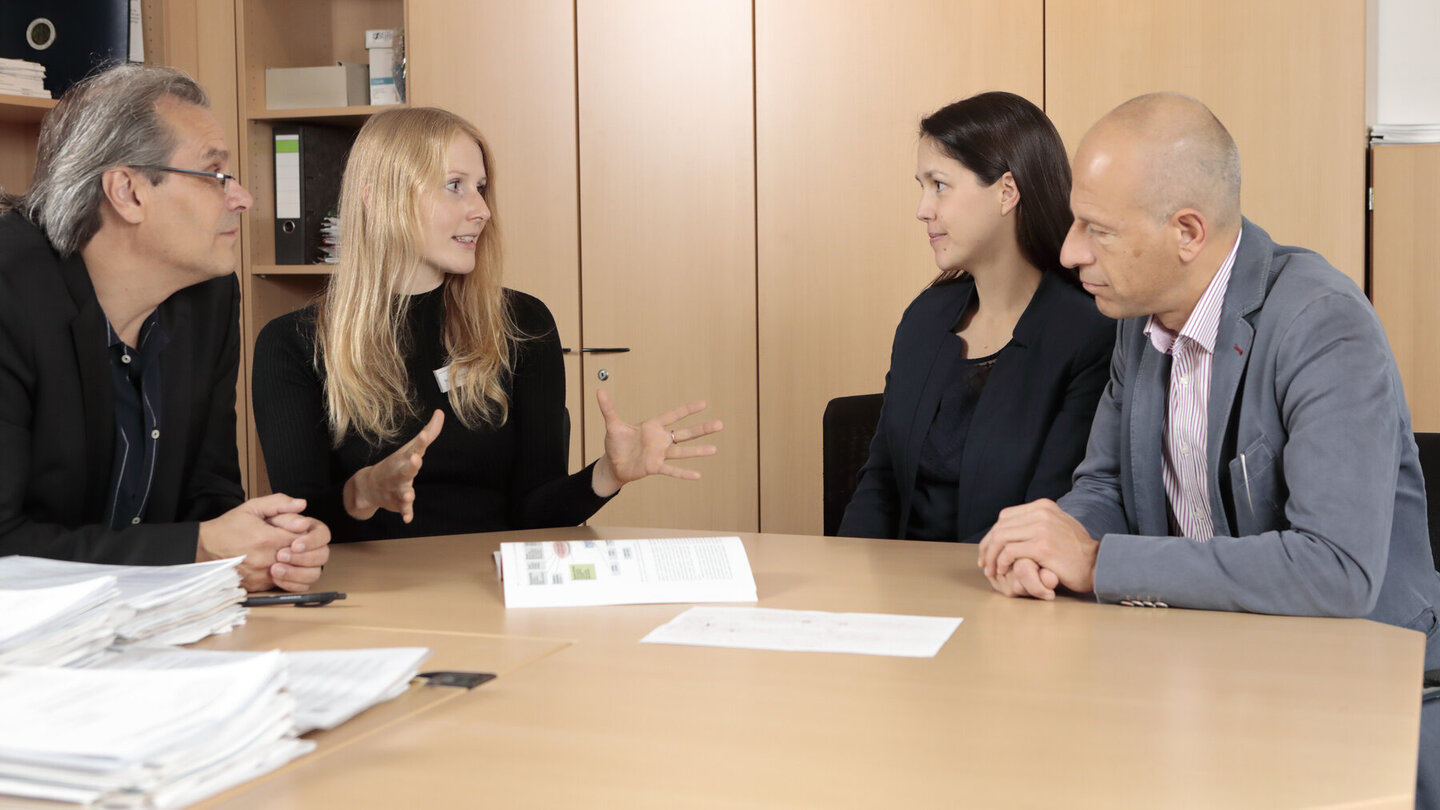
The Center for Undiagnosed Congenital Syndromes and Clinical Genome Medicine is part of the Center of Rare Diseases Göttingen (ZSEG) and is organized jointly by the Institute of Human Genetics and the Department of Pediatrics at the UMG.
By combining our outstanding scientific and clinical expertise, we aim to establish a precise diagnosis in children with unclear congenital syndromes as early as possible and to determine the genetic cause of their condition.
An early and correct diagnosis is very important for the affected children and their families. It provides the basis that allows to make statements about the course of the disease and to take decisions on therapeutic approaches and further steps in the care of these children. It is also essential to answer pressing questions for the families, for example, regarding the risk of recurrence of specific syndromes.
What is a syndrome?
A syndrome is a congenital condition characterized by several features occurring together. These features may either be present at birth or may become present during childhood or adolescence. They can involve different organ systems and may for example include malformations of the head, the face or the limbs, dysfunction or malformations of organs, short stature or developmental delay.
What is the cause of a syndrome?
Most syndromes have a genetic basis, although we do not know for all syndromes by what genetic change they are caused.
Why is it often so difficult to diagnose a specific syndrome?
Congenital syndromes are often clinically and genetically heterogeneous. Conditions that are caused by the same genetic change may present very differently and, vice versa, syndromes may look very similar although they have a different genetic cause. This makes them difficult to diagnose by genetic testing if one uses the conventional method where only single genes or multiple known disease genes are analyzed in a steplike process. And many patients show unspecific or overlapping symptoms that are difficult to attribute to a distinct known syndrome for a clinical diagnosis.
Research on Rare Syndromes
Many congenital syndromes are extremely rare and we do not yet know their genetic cause. Unravelling such diseases is one of our main research areas. Using next generation sequencing technology, we perform whole exome and whole genome sequencing to search thousands of genes or even the entire genetic material of a patient to find causative changes (mutations).
Our specialized Mutation Mining (MM) Team of scientists and clinicians analyzes and interprets the data generated in our research study on undiagnosed congenital syndromes and searches for possible causative variants. Then our research groups perform functional analyses to find out whether the cellular and molecular effects of the identified mutations can explain the patient’s condition. Using this approach, we are increasingly able to attribute unclear congenital disorders to changes in genes that are either known to be involved in human diseases or have not yet been described as disease-associated genes. Novel genes revealed by us in 2018 include for example CHD3 and NEK3, and it has been shown that a molecular diagnosis can be established in the majority of cases investigated in our research study.
Clinic for Undiagnosed Congenital Syndromes in Children
Our clinic is held jointly by physicians from the Institute of Human Genetics and the Children’s Hospital. Clinical examination, diagnostic assessment and genetic counselling can thus be provided to the families at one visit. If needed, specialists from other departments will join the multidisciplinary team.
When we see a child at our clinic, the findings from the clinical examination and the information we gain from previous tests and medical records may allow us to attribute the symptoms to a distinct syndrome. In such cases, we will discuss with the family whether it is possible and helpful to confirm the diagnosis by a genetic test. If the clinical picture does not suggest a known syndrome, we may offer the family to participate in one of our specific scientific studies which we perform in third-party funded research projects, for example, on microcephaly, skeletal disorders, craniofacial malformations and others. In these research studies, we use the latest sequencing technology to identify the genetic causes of undiagnosed syndromes.
Appointments
The clinic is held at the Department of Pediatrics at regular intervals. You need to make an appointment for your visit.
Tel.: +49 (0)551 3913241
Fax: +49 (0)551 3913245
Email: spz(at)med.uni-goettingen.de
Department of Pediatrics
Community Pediatric Service (Sozialpädiatrisches Zentrum, SPZ)
Clinical Contacts
contact information
- e-mail address: matthias.kettwig(at)med.uni-goettingen.de
secretariat
- telephone: +49 551 3969100
contact information
- telephone: +49 551 3964477
- e-mail address: bernd.wollnik(at)med.uni-goettingen.de
secretariat
- telephone: +49 551 3967589
- e-mail address: manuela.manafas(at)med.uni-goettingen.de
Board of Management
- Prof. Dr. Bernd Wollnik (Speaker), Department of Human Genetics
- Prof. Dr. Knut Brockmann (Deputy Speaker), Community Pediatric Services (SPZ)
- Prof. Dr. Jorge Frank, Department of Dermatology
- Dr. Verena Gravenhorst, Department of Pediatric Cardiology
- PD Dr. Silke Pauli, Department of Human Genetics
- Dr. Dagmar Weise, Department of Pediatrics
Participating Departments and Institutes
- Department of Human Genetics
- Community Pediatric Services (SPZ)
- Department of Pediatrics
- Department of Pediatric Cardiology and Intensive Care
- Department of Neurologic Surgery
- Department of General Surgery
- Department of Trauma, Orthopedic and Reconstructive Surgery
- Department of Ophthalmology
- Department of Cardiology and Pneumology
- Department of Diagnostic and Interventional Radiology (Pediatric Radiology)
- Department of Dermatology, Venerology and Allergy
- Department of Diagnostic and Interventional Neuroradiology